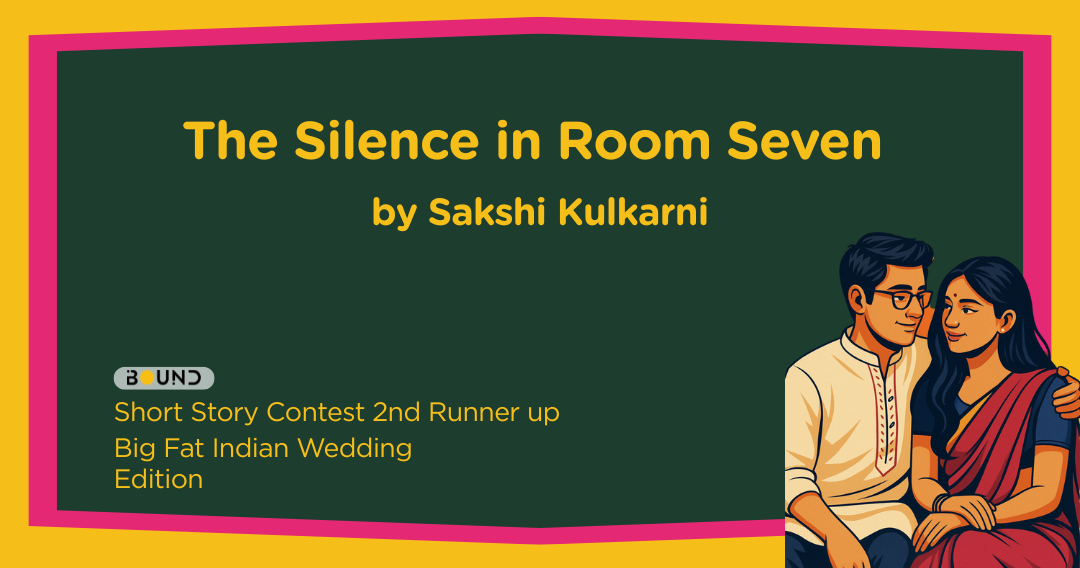
The air in Room Number Seven of the City Marriage Registrar’s office was not just thick; it was actively suffocating. It smelled of three conflicting entities: stale government paper, the metallic tang of anxiety, and the competing perfumes of fifty people crammed into a space designed, generously, for six. The room itself was a low-ceilinged box painted institutional beige, featuring a peeling notice board that listed the ‘Fines for Spitting’ and a single fan that merely redistributed the heat and the chaos.
Pallavi, usually a woman of calm, measured certainty, felt her equilibrium dissolving. She was a proper Marathi, her roots deep in Pune’s culture. Her groom, Karthik, was pure Kannada, a man of Bangalore, whose family’s traditions were as rigorous and detailed as any ancient scripture. Their attempt at a simple, inexpensive court wedding had become an elaborate, cultural pressure cooker.
Her chosen outfit—a sophisticated, deep-maroon silk saree with a gold border—was meant to be an elegant compromise. A subtle nod to her Marathi heritage, a respect for the occasion, and, crucially, light enough to move in.
“You look like you are going to a bank, not becoming my daughter-in-law,” Karthik’s Amma muttered, her voice a low, gravelly disapproval in Kannada that Pallavi had learned to translate through sheer practice. “For shame, Pallavi. A Kannada wedding, even a tiny court one, should have the bride in a full traditional saree, yellow and gold, heavy enough to show the weight of the moment. Why did you even refuse to wear that beautiful mysore silk saree in the first place? It would’ve looked royal on you. Even Karthik came wearing this loose kurta. You both lack gravity.”
Pallavi forced a smile that felt brittle. “Amma, we are just signing a paper, not starting a silk museum. I wanted to be practical.” Practicality, she knew, was a foreign concept to the wedding traditions of both their families.
The fifty wedding guests had neatly and instinctively divided the small room in half, forming two distinct, rival camps.
On the left, under the flickering fluorescent tube, stood the Marathi contingent. They were loud, jovial, and treating the court waiting area like a picnic spot. Pallavi’s Aai, Mrs. Kulkarni, was fanning herself with a magazine while her younger cousins—about twelve of them—were giggling and filming everything on their phones, their high-pitched commentary blending into an audible buzz. The most dominant figure was her Mama (maternal uncle), a man of theatrical proportions who wore his excitement like a brightly colored flag. He was already passing around homemade chivda and crunchy shankarpali from a massive metal tin hidden inside a cloth shopping bag, loudly offering them to the Kannada side as if throwing down a gauntlet.
“Come, come! Try the Pune special! It will give you energy for this long signing process!” Mama boomed, oblivious to the “Fines for Spitting” notice directly above his head.
On the right, clustered by the water cooler, stood the Kannada contingent. They were solemn, dressed in starched, austere silks, and regarded the Marathi exuberance with visible distress. They viewed the Marathi group’s laughter and snack-eating as a profound lack of reverence for the auspicious muhurta. Karthik’s Amma was the general of this army, her dark eyes constantly scanning the room for signs of inauspicious behavior.
“They are supposed to be praying quietly now, focused on the transition,” Karthik’s Uncle muttered to Amma in hushed, furious Kannada. “This tamasha is polluting the ceremony.”
Karthik himself was sweating through his pristine white silk kurta. He was negotiating with the registrar, Mr. Jadhav, a government clerk who seemed to view the entire legal process as an elaborate form of psychological torture.
“Section 4G, Subsection B, Annexure 2… where is your paternal grandmother’s proof of residence from 1985?” Mr. Jadhav demanded, his voice a dry, accusatory drone.
“Sir, my grandmother passed away! And this is just to register a marriage, not solve a cold case!” Karthik pleaded, clutching a massive, disorganized folder of documentation.
The official signing time, the muhurta, was calculated by the family priest for exactly 11:37 AM. It was 11:34 AM, and they were nowhere near being ready. The pressure was turning Karthik into a human barometer of stress.The small room soon erupted into an epic and highly localized conflict.
It began with the Cuisine War. Pallavi’s Aai approached Karthik’s Amma, attempting a truce by pointing out their shared vegetarianism.
“Amma, at least we are all eating vegetarian today, yes? Very good, very pious,” Aai said, adjusting her spectacles. Karthik’s Amma, however, was already in attack mode, fixating on the chutney that Aai had brought in a small steel tiffin box. “Yes, vegetarian. But I hope you have not brought that fiery, crude chutney from Pune. It is too sour. It overpowers the palate. Our Kannada chutney is made with coconut and a delicate balance of spices—it is a complement, not a competition. It is spiritual.”
“The Marathi chutney is the heart!” Aai retorted, her voice rising. “It is fiery! It shows strength and passion! Your coconut chutney is like water—sweet and timid! This marriage needs strength!”
The conversation immediately devolved into a furious, multilingual debate over the superior psychological and spiritual properties of various regional chutneys, dragging both fathers into the fray, arguing in Marathi and Kannada about whether kanda poha (Marathi) or shavige bath (Kannada) was the truly superior morning staple.
As the clock ticked to 11:35 AM, the cultural absurdity reached its peak with the Theatre of Tradition. Pallavi’s Mama, now energized by a large helping of , called out loudly. “Pallavi! Our cousin, Vikas, has composed a very special, original poem for the occasion! Come, stand in the center! It celebrates the fusion of the Deccan and the South!”
“Mama, no! We are in a government office!” Pallavi hissed, a wave of heat rising in her neck.
But it was too late. Vikas, a skinny young man with an oversized red and white tilak on his forehead, stood proudly. He cleared his throat and began reciting his passionate Marathi poem, which he titled: ‘Tu Chandra Cha, Mi Chandrika’ (Be the Moon, I will be the Moonlight).
Vikas began, his voice soaring over the general din:
“O, Lord of the sanskars, bless this bond,
When the Maharashtra tika meets the Karnataka gandha!
Tu Chandra Vha, my dear Karthik, steadfast and strong,
And I, your Pallavi, the soft Chandrika, where you belong!
The fortresses of the Sahyadri mountains embrace the temples of Mysore,
A thousand years of love, forevermore!”
The poem was high-pitched, loud, and designed for an auditorium, completely filling the small room with flowery, over-dramatic Marathi verse.
Karthik’s Amma instantly counter-attacked. She pulled out a small, heavy metallic puja bell from her handbag—a traditional, highly charged item—and began ringing it sharply. She faced the corner and began chanting a brief, intense Kannada Shanti Paath—a protective prayer designed to remove obstacles and purify the space.
Ding-a-ling. Ding-a-ling. Ding-a-ling. The sound was sharp, metallic, and aggressively persistent. The chant was low and rapid, intended to spiritually cleanse the space of the “unnecessary noise” of the poem.
The result was an unbelievable sensory assault: a high-volume, flowery Marathi poem battling a high-frequency Kannada puja bell, all while the two fathers argued about the sweetness of laddoo.
Karthik was now standing at the counter, shaking, clutching the file. The clerk, Mr. Jadhav, was looking at his watch, completely unaffected by the cultural war, only by the impending doom of his lunch break.
“It is 11:36 AM. Get your bride and sign! I don’t care if you need a poem or a priest, just sign the paper!” Mr. Jadhav snarled.
Karthik rushed to Pallavi. The moment he sat down, the family surged. Pallavi’s Aai was adjusting her hair, her eyes scanning for the best camera angle. Karthik’s Amma, still ringing the bell with one hand, was trying to quickly whisper the final, crucial Kannad mantra into his ear with the other. The two uncles were shoving each other, fighting over who was senior enough to sign the witness line first.
“Amma, please, a little space! I can’t breathe!” Karthik pleaded, his voice thin.
“No! The paper must be signed now! It is the muhurta time! Any delay is bad luck!” his Kannada uncle shouted, trying to physically block Pallavi’s Mama.
As the Marathi Mama forcefully shoved his way past Karthik’s uncle, he accidentally hit Pallavi’s shoulder. The movement caused her hand to knock the pen off the table. The pen hit the dusty government floor with a small, sharp clack. That tiny sound was the final fracture. Pallavi’s eyes, wide and terrified, clamped shut. She let out a small, utterly defeated sob—a choked sound completely swallowed by the surrounding cacophony of bell, poem, and arguments. She felt the pressure in her head become a physical, blinding pain. She wasn’t an individual woman getting married; she was just the prize at the center of a cultural tug-of-war.
Karthik saw it. He didn’t hear the sob, but he saw the collapse of her face, the pure, raw surrender in her posture. The stress of the last three days—the documentation, the finances, the endless negotiations—all coalesced into a single, white-hot, protective rage.
He dropped his file. He sprang up, knocking his chair back with a tremendous thud that finally, gloriously cut through the noise. He turned, facing the wall of fifty people who loved them too much, and roared, his voice low, guttural, and absolute:
“ENOUGH! STOP! Everyone, just SHUT UP, all of you! NOW!”
The volume and shock were instantaneous. The poem died mid-stanza. The bell stopped ringing, its silence deafening. The room froze into a magnificent, horrified paralysis.
Karthik’s chest was heaving, but his voice, though lowered, was steady.
“Look at her,” he commanded, forcing every eye onto his bride. “This is the day we become one. And you have made it a fight over CHUTNEY AND CASTE AND CONVENIENCE. Pallavi is not a Marathi princess marrying a Kannada king! She is a woman marrying the man she loves! And you have broken her.”
He walked the final few steps to Pallavi and gently placed his hands over hers, unwrapping her desperate grip. He kept his gaze locked on the room, then looked directly at his mother and her mother, their faces masks of shock.
“We need five minutes of silence for our marriage,” he announced. “If you cannot give us that, then please, step outside.”
Karthik turned back to Pallavi. The ferocity in his posture instantly dissolved, replaced by a profound, gentle calm. He didn’t say a word. He didn’t need to. He simply adjusted the fold of her saree that had crumpled during the chaos, smoothing the cloth with a reassuring touch.
He offered her a slow, steady gaze that spoke volumes: I saw you. I stopped the world for you. We are safe now.
Pallavi looked up at him. Tears of pure relief now tracked a path through her makeup, but they were silent. In that moment of absolute silence, sitting at the dusty table, she saw her future husband—not the stressed-out groom, but her champion, her shield, the man who understood that their quiet, shared love was infinitely more sacred than any religious or social spectacle.
A single tear, heavier than any gold thali, slipped down her cheek. She didn’t speak the words, but the profound gratitude in her wide, dark eyes was clearer than any poem. Thank you. You saved us. The intimate, thoughtful bond between them was the only thing that mattered in the room. Karthik gave her a faint, knowing smile—the intimate acknowledgment of their shared victory.
He picked up the pen and signed the register. Pallavi, her hand now steady, signed beneath him. The two nominated witnesses, terrified into compliance, signed quickly. Mr. Jadhav, the clerk, stamped the paper with aggressive finality.
It was done. They were married. The noise gradually returned, but it was subdued, a chastened murmur rather than a roar. Karthik’s Amma was the first to approach. She rushed not to argue, but to embrace her son and then Pallavi.
“My sweet girl,” she murmured, wiping the tears from Pallavi’s cheek. “We love you. We were just… making noise.” The Kannada rigor had given way to genuine maternal concern. Pallavi’s Aai rushed over, holding her tight, apologizing for the drama.
Karthik took Pallavi’s hand, pulling her away from the congratulatory line. They stood by the door, watching their families—the Marathi drama queens and the Kannada traditionalists—cautiously mingling, quietly passing around the disputed chivda and the small, metallic bell.
“You know,” Pallavi murmured, her voice soft with lingering emotion. “That outburst… it was so effective. It had the authority of a thousand Kannada mantras.” Karthik chuckled softly, squeezing her hand. “Well, your Marathi Mama taught me how to yell. And my Kannada Amma taught me how to make it sound like a decree. I am a man of two worlds, my darling. Which means I know exactly how to use chaos to create calm.”
They stepped out of Room Number Seven and into the sunlight. The paper was signed. The wedding was over. It wasn’t traditional, simple, or fat. It had been loud, absurd, and stressful. But in the midst of that storm, they had discovered the true, profound silence of their intimate, unbreakable bond. That, they both knew, was the greatest story their wedding could ever tell.