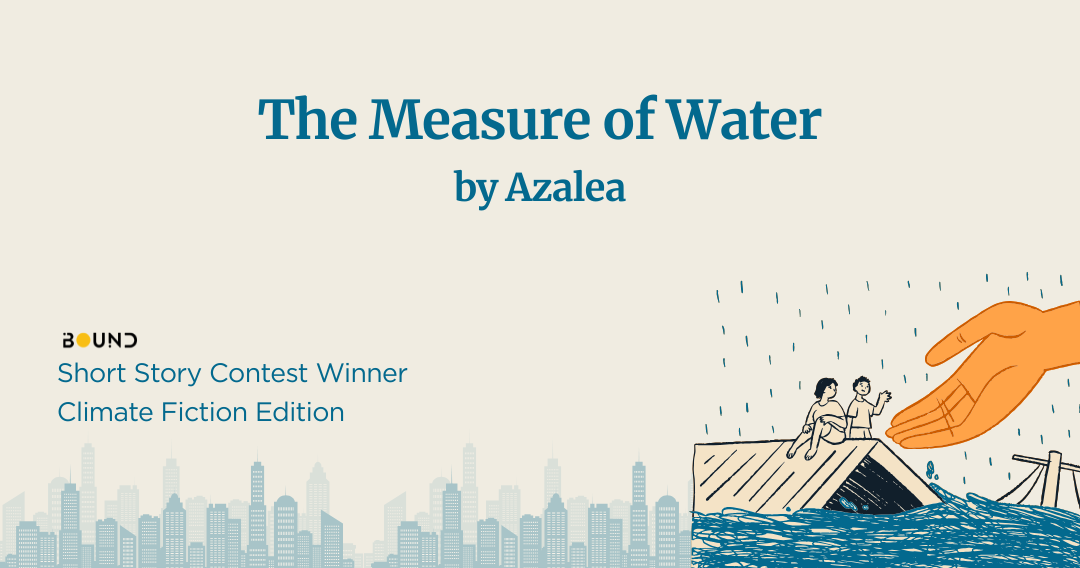
They used to mark the wall with a pencil every year, as the river started to behave abnormally. The line was slightly lighter, and it was drawn near the kitchen door. The morning light is coming out of the kitchen grill; the cooker whistles and settles down for breakfast. Meera was cleaning the front space, as there was mud all over. It was monsoon season; the water came quietly, without warning, the night before and came up to the front space, but it dried down, leaving the mud alone. “I think the river will rise again, Aachi.”
Her grandmother slightly laughs and says, “You are just taking it seriously; the river has been providing for us for so long, it knows its limit.” But the river seems like it won’t listen to anyone anymore.
The house stood on the edge of the village; across from it the paddy field began. The river flows through and slowly curves beyond the coconut and tamarind trees. On the bank of the river grows tall grass and wild plants; the watercourse made the paddy field greener than ever. The people of the village hang a red cloth on trees near the river, half for prayer and half for warning.
Her grandfather built the house many years ago. This land originally belonged to a colonial officer who later transferred it to her grandfather. Her grandfather used to till rice in the field for him. The land was not only granted to him but also to many others who are now residing in their village. Her grandfather built the house with thick bricks, thinking, ‘Once faithful, always strong forever.’ Every Pongal, their house was whitewashed and smeared with cow dung for a clean, sharp smell. From the back of the veranda, the surface of the river flows gently and sparkles from the rays of morning light.
The government has declared their land encroachment. There were no official papers to show proof. It’s been almost a decade, yet their village is still fighting for the rights of the land. We know the government has a plan to extend the construction of the dam. Since then, engineers from Chennai have monitored the river, while operators from Trichy have managed the water of the dam.
In the summer the water shrinks. The boys will walk barefoot, and the woman will wash their clothes on the rock near the bank of the river. Men bathed early in the morning, whispering prayers by submerging in the water. The water always stayed where it was supposed to.
But during the monsoon, the river gradually rises. The elders notice the signs. The sky warned them. In the past few years, however, the water has arrived unexpectedly, without any warning. Initially, the water gradually rose to the veranda, then by the next monsoon, it touched the first step of their house. And last year, it entered their house. The water markings are moving higher and higher. Her grandmother will mark it properly; she draws the line and writes the date beside it. The guests have asked, “What are these lines for?” But her grandmother will make excuses for it. We raised the alumni cupboard with bricks and kept the rice sack on the kitchen platform. The fish was trapped in the small pool near the veranda. And that’s where her grandmother marks again with the pencil.
“Too much water, too much sun,” Meera complained.
“There is nothing wrong; you are just too weak to handle this climate. Eat plenty,” replied her grandmother.
Her grandmother always says it to comfort herself. But in reality, she doesn’t sleep for days. Every slight sound of anything will wake her up. Every rain cloud is a threat to her. Each year the line climbed. Even her mother is more obsessed with this place, even though she works in Chennai.
Two years ago, her father died of a heatwave, but the officials referred to it as unusual. The doctor reported heart failure due to dehydration. Heat was never recorded unless it killed dozens of people. Small deaths from small villages are usually ignored. Her father’s last lunch was sambhar rice and murungai keerai (drumstick leaves). After he ate, he went to sleep and didn’t wake up; that was his last breath.
After her father died, the house felt watched. Her mother began to give things that carried his memory: his clothes, wedding saris and more. Still she didn’t lose hope. She always speaks of the future, the small house, which the government can snatch at any time, and also the flooded fields. The office where she used to work is now considered absurd, which is why she returned from Chennai.
“You have returned at the right time,” excitedly says Meera. “They have opened the dam; now we can have plenty of water for our field.”
But they didn’t know that this opening of the dam could change their life forever.
Meera noticed the rain clouds; scared, she told her mother. Her mother comforted her, but still something was lingering in her mind, and her heart was beating faster than usual. She didn’t sleep at night; her mother and her grandmother were already asleep. Looking out of the window, she saw the sky had burst open, releasing the sudden downpour; it went on for hours straight.
The next morning, they had their routines as usual, but the rain didn’t stop yet. The water had already begun to rise, and it reached the veranda. Meera made some boats and let them float on the water. She even noticed some fish had grown a bit. She saw a few boys enjoying the rain and playing in it. By afternoon, the rain poured heavily; it reached the doorstep. She and her mother started moving things to higher places. Some were kept on the kitchen platform, and a few were kept in the cupboard. Important papers and government cards: ration, Aadhar and PAN cards were all kept inside the plastic cover and placed in the cupboard. Her grandmother was praying in front of the pooja shelf, located near the entrance. The rain took a break; her grandmother got a slight relief. Her mother went and purchased the household essentials. Until night, it didn’t rain. But that was the last night for a few people.
The rain started pouring heavily, Meera noticed. She thought maybe her grandmother might be sleeping, but no. The power has been out since the evening; it hasn’t come on yet. “Aachi, I can’t sleep in this loud noise of thunder.”
“Close your eyes and sleep; you will sleep soon.”
No warning, no announcement. Suddenly, a loud noise. Everyone is woken up.
“What happened?”
“What was that noise?”
“Amma, look, waterrr…”
Everyone was shocked, “Ayoo…” The kitchen roof fell off. The water has overflowed beyond all the pencil markings on the wall.
Her mother touched the wall and started to cry loudly. “My house is falling apart… my only life is drowning.”
Her grandmother comforted her and told her we need to leave, but her mother didn’t want to. Meera packed a few clothes, and her grandmother secured the important government documents. Her mother stood by, one hand on her head and another on the wall, still reeling. Her grandmother took her by the hand, and they left the house at midnight.
At the school hall, they were all counted and asked for their names, addresses, castes and ownership rights to the house. Families were split, as the school was too small for the whole village. Many were shifted to a far-off marriage hall. Meera and her mother and her grandmother were fortunate to have moved to the marriage hall, as it was spacious; however, they were still in devastating condition, thinking about their home. One of them was saying that “one side of the dam was broken down due to the pressure of water when they opened the dam”; her grandmother heard, “Till now at least ten people had died in the flood.” Her grandmother got shocked and asked who had died, but they said they don’t know yet.
The next day, many volunteers arrived to help the affected individuals. A few volunteers went on a boat to rescue other individuals who remained stuck. The disaster affected everyone, not only their village but also many neighbouring villages. The officials continued to collect the details and ask about others. Meera still cannot see her friends; she is still scared. Her mother lost all hope about her land and home. Already the people are facing trouble due to encroachment, and now this rain has made it easy for the government to capture the land.
The cameras and news reporters dispersed, but they quickly departed. Relief rice arrived slowly, but the amount provided was insufficient for everyone. The entire hall was wet; there was no proper place even to stand. The roof was cracked and causing water to drip inside. The walls were chilly. The blankets were given only to the influential people; the rest awaited. Children cried, and no one was able to comfort them because of the devastation that caused.
At night, the rain continues to pour. The rain beat on the tin roof. No one slept. A few families were separated, so they missed their loved ones and felt worried and asked officials to call them. No current. No mention of compensation. No guarantee of return.
Her mother was watching the rain, thinking about the rest of the house. “The water might have risen to the Pooja shelf. I don’t know whether the house will be in its place or whether it will have floated away.”
“No da, this river has supported us; it won’t take the house with her,” replied her grandmother, comforting her mother.
“When will it stop, Aachi? I want to go home.”
“Soon, Meera, soon.” Her grandmother herself was looking into the sky and whispering prayers to stop this rain and safely return to their home.
They all returned to their houses after two weeks; the house stood but changed. Mud was coated on the walls all over. The smell was strong and unbearable, like that of rotten eggs. The government officials
arrived and made an announcement to the people to vacate this place, as the construction of the dam will begin immediately and has to be completed before the next monsoon.
Meera looked at her mother. “What shall we do now, Amma?”
The police began to evacuate the people; they were all armed with lathis. The police just allowed the people inside to collect their belongings. Many were loudly crying; a few were hugged to the wall so that they wouldn’t leave. There were loud noises of crying, and the police urged everyone to vacate quickly, or else they would lathi charge.
A constable entered their home, asking them to vacate. Her mother went to the kitchen and saw the broken roof; the sky looked calm and peaceful. She went near to the cracked slab and took a pencil. The constable watched. “Take your things and leave soon; don’t expect that I hold back because you all are women.” Meera and her grandmother started taking a few things quickly. Her mother went near the kitchen door and marked the line and wrote the date. The constable said, “It is no use now,” and laughed.
Her mother quietly said, “But it is useful to me.” The constable stopped laughing.
The people started to leave the place. The lathi charge has already started. Loud cries and shouts erupt from the crowd. The constable took his lathi, and her grandmother said, while dragging Meera along, “We are leaving,” and cursed him.
Families from lower castes like them have no protection. Now they have no job, no support and no house. The houses were marked for demolition. Few people went to their distant relatives’ houses, and few people rented houses in the area. Her mother rented a house near the highway, with no river, no field, only noises and dust. The government told of the compensation, but it didn’t come yet. The rich and politically connected got the help quickly; the rest, including them, are still waiting.
Her mother took the key, wrapped it in a red cloth and placed it near the gods, hoping the house and the land would get back to them.
At night, when it rained, her grandmother sat up and whispered, “They say the river is angry.” “No,” her mother said, “The river is being used.”
Her grandmother nodded slowly, unconvinced.
Months later, her mother began working as a domestic helper for a wealthy family. Although they sometimes mistreated her, she had no choice but to endure it to support her family. Meera’s friend informed her that the government had begun to demolish their homes and the dam work had started. Meera told her mother about their home, but her mother already knew about it.
The government was building a wall upstream, not to stop flooding but to protect certain factories that captured their land. The government had received a large sum of money from the private corporation. The government didn’t pay monetary compensation; instead, they displaced all the individuals to do work in the factory, and they will pay a decent wage, but the future will know. Her mother was still holding the pencil, ready to mark. Meera asked,
“Why?”
Her mother replied, “Somewhere the water is already rising, and this time, it won’t ask permission.”