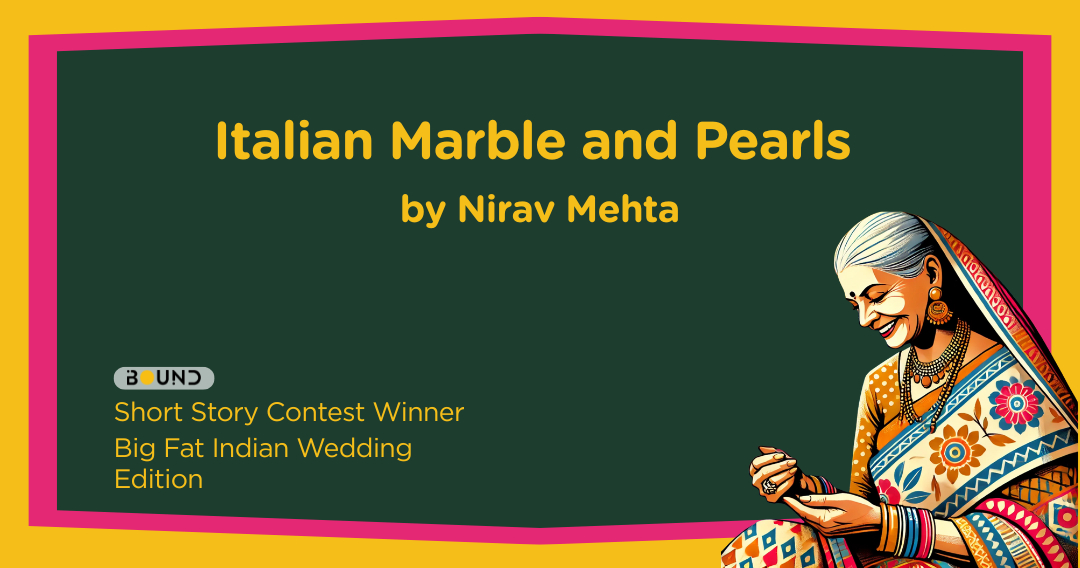
Ba was eighty-three years old, barely five feet tall even in her best slippers, and she was about to go to war.
She sat on the corner of the sofa in her granddaughter’s flat in Ghatkopar and surveyed her troops. Thirty-two relatives crammed into a living room meant for maybe fifteen, all talking at once, all eating farsan from the shop downstairs. This was the first official wedding planning meeting for her youngest granddaughter, Nisha, and Ba had opinions.
Ba always had opinions, about everything from Narendra Modi’s economic policies to the proper ratio of sugar to cardamom in chai (three parts to one, and if you disagreed, you were morally suspect). But today’s opinions mattered more, because today they were discussing the wedding that would unite their family with the Shahs of Borivali.
The Shahs.
Ba wore only white sarees since her husband’s death forty-three years ago. Today she’d added her pearls, the ones her mother had sewn into her skirt hem during Partition, the ones that had survived three moves across Bombay as rent prices pushed them east from Girgaon.
Those pearls meant business.
She waited until everyone settled, then spoke. When Ba spoke, people listened.
“The Shahs think they are very big people.”
The room went silent.
“They have that big house in Borivali with Italian marble in every room. That import-export business making I-don’t-know-how-much money. Relatives in America, England, Africa even.” She paused. “And they think our Nisha is lucky to marry their Mihir.”
“Ba,” Nisha tried to interject, “Mihir is actually very nice.”
“I’m not saying the boy is not nice! I’m saying his family doesn’t know what luck looks like. Luck is not Italian marble. Luck is a girl raised with proper values, who respects her elders, who makes the best handvo in three generations.”
The room erupted in agreement.
“We will show them,” Ba declared. “We will give them a wedding they will never forget.”
What she didn’t say: that she was tired of families like the Shahs making families like hers feel small. That she’d spent a lifetime being pushed east across this city, always being told the west was better, that marble was better, that they weren’t quite enough.
This wedding wasn’t just about Nisha and Mihir. It was about proving that families like hers mattered.
The gol dhana ceremony was supposed to be intimate, “just immediate family.” But “immediate family” in a Gujarati household could include seventy-eight people.
The Shahs arrived in three cars simultaneously, suggesting military-level planning.
From the first car emerged Mihir’s mother, Chandrika Shah, wearing a Kanjeevaram saree in peacock blue that probably cost more than a down payment on a one-BHK in Mira Road. The gold jewelry she wore was a statement, a declaration of wealth.
Ba watched from her designated perch. She was dressed in white silk, but today she’d added her pearls, the
good ones.
“Kokila,” Ba said in Gujarati, her voice pitched to be overheard, “did you see? They came in three cars.
THREE. In my day, we took the bus.”
“Ba,” Kokila hissed, “times have changed.”
“Times have changed, yes, but petrol prices are now hundred-and-ten rupees per liter!”
Chandrika Shah approached with folded hands. “Pranam, Ba. You look wonderful. Those pearls are beautiful.”
“Thank you, beta,” Ba replied, her tone sweet as jalebi. “Your saree is also very beautiful. Very expensive-looking.”
The ceremony itself was beautiful. Nisha and Mihir sitting cross-legged on the floor, surrounded by brass thalis, the pandit chanting Sanskrit mantras. But Ba couldn’t stop watching Chandrika, the way she smiled at everyone, that polished confidence that came from never having worried about rent.
Then came the gift exchange.
Kokila had prepared respectable gifts. A silver tea set. A Banarasi silk saree. Gold cufflinks.
The Shahs presented their gifts with dramatic flourish. For Nisha: a diamond necklace set in white gold. For Kokila: a designer saree from a boutique that only took appointments. For Pravin: a Tag Heuer watch.
The gifts sat between the two families like a challenge.
Ba felt her jaw tighten. She wanted to say something cutting, something that would puncture that Shah smugness. But when she looked up, she caught Nisha’s eye. Her granddaughter’s face was pale, strained. Caught between two families, two worlds, trying to hold them both together.
Ba looked away.
“Such generous gifts,” she said finally, her voice neutral.
But later, after the Shahs had left in their three cars, after the relatives had dispersed, Ba sat alone in the living room, her pearls heavy against her collarbone. Kokila was in the kitchen, putting away the brass thalis.
“Ba?” Nisha appeared in the doorway, still in her ceremony clothes. “Are you angry?”
“Angry? Why would I be angry?”
“You were so quiet during the gifts. That’s not like you.”
Ba wanted to say: because their diamonds make our silver look cheap. Because they came here to show off, not to celebrate. Because I’ve spent my whole life being told I’m not enough, and I’m tired, Nisha. I’m so tired.
Instead she said, “I’m fine, beta. Just old. These long ceremonies, you know.”
Nisha sat down beside her, rested her head on Ba’s shoulder. “I know this is hard. Two families, different…different everything. But Mihir is good, Ba. He really is.”
“I know,” Ba said. And she did know. She’d watched the boy with Nisha, the way he looked at her. Like she was the whole world.
“Then can you try? For me?”
Ba closed her eyes. The pearls felt like a weight, like history pressing down on her chest.
“I’ll try,” she said.
The mehendi was held at a small hall in Chembur, transformed into a garden of marigolds and roses. Ba arrived early, helped Kokila set up the sweets table, arranged the flowers. Keeping busy. Keeping her hands occupied so her mind wouldn’t wander.
The Shah women arrived in coordinated mint green and gold, all of them, like a synchronized dance team. Ba, in her white silk saree, felt suddenly old, suddenly out of place.
She found a chair in the corner, away from the main crowd, and watched the henna artist work on Nisha’s hands. The dhol player started up. Women began dancing. The hall filled with laughter, with music, with that particular joy that comes before weddings.
Ba felt nothing but tired.
“Ba?”
She looked up. Mihir stood there, holding two cups of chai.
“I made this for you,” he said shyly. “Nisha taught me. Three parts sugar to one part cardamom, right?”
Ba took the cup, surprised. She sipped. It was perfect.
“Good boy,” she said softly.
He smiled, relieved, and returned to Nisha’s side. Ba watched him go, watched how he touched Nisha’s shoulder gently, how she leaned into him without thinking. The ease of it. The trust.
She remembered that ease. Before her husband died, before she’d learned to be hard.
“That seat taken?”
Chandrika Shah stood there, holding a plate of mohanthal.
Ba gestured to the empty chair. “It’s a free country.”
Chandrika sat down, set the plate between them. They sat in silence for a moment, watching the dancers.
“Your granddaughter is lovely,” Chandrika said finally.
“Thank you.”
“Mihir hasn’t stopped talking about her for six months. It’s been nauseating, honestly. But also… sweet.”
Ba said nothing. She didn’t trust herself to speak without the bitterness showing through.
“Ba,” Chandrika said, and something in her voice was different. Quieter. “I know you don’t like me. Or my family. I know you think we’re showing off. With the cars, the gifts, all of it.”
“I didn’t say that.”
“You didn’t have to.” Chandrika looked down at her hands. “You’re right, though. We are showing off. I am showing off.”
Ba turned to look at her, surprised.
“My mother died when I was twelve,” Chandrika said, still not looking up. “She was a schoolteacher in Surat. We had nothing. Less than nothing. My father was a clerk in a textile mill. When my mother died, everyone said he should send us to relatives, that he couldn’t manage three daughters on his own.”
Ba went very still.
“But he didn’t. He worked. He saved. He denied himself everything. Food, medicine, everything. When I got married, he wore the same coat he’d worn to my mother’s funeral because it was the only one he had. The Shahs, my in-laws, they looked at him like…” Chandrika’s voice broke slightly. “Like he was something they’d scraped off their shoe.”
Ba felt something crack open in her chest.
“My husband saw it. Saw how they treated my father. And he swore, right there, that no one would ever look at his family like that again. So he built the business. Bought the house. The marble, the cars, all of it. Not because we needed it. Because we needed everyone else to see that we were worth something.”
Chandrika finally looked at Ba. Her eyes were wet.
“Every time I wear expensive jewelry, every time we arrive in three cars, I’m thinking about my father in that coat. I’m thinking: look at us now. Look at what we survived. We matter. We matter.”
Ba couldn’t speak. Because she understood. God help her, she understood completely.
“The pearls,” Ba said finally, her voice rough. “My mother sewed them into her skirt during Partition. We had fifteen minutes to pack. Fifteen minutes to choose what was worth saving. She chose these.” Ba touched her throat. “I wear them to remind myself that we survived. That we’re still here. That they couldn’t break us.”
“So we’re the same,” Chandrika said. “Both of us fighting the same war. Just from different sides.”
“The children aren’t fighting,” Ba said.
“No. They’re not.” Chandrika looked across the room at Nisha and Mihir, sitting together, laughing at something. “They don’t carry what we carry. They’re lighter than we are.”
“Maybe that’s good.”
“Maybe.” Chandrika was quiet for a moment. Then: “I’m sorry. For making you feel small. I was trying to make sure no one could make me feel small ever again. But I hurt you. I see that now.”
Ba felt the tears before she could stop them. When was the last time someone had apologized to her? When was the last time someone had seen her hurt and named it?
“I’m sorry too,” Ba said. “I was so busy defending myself, I didn’t see… I didn’t see that you were defending yourself too.”
They sat together in silence, two old women who’d survived too much, carried too much, fought too long.
“This mohanthal is very good,” Ba said finally.
Chandrika laughed, a real laugh. “It’s from that shop in Matunga.”
“I know. I can taste it. Store-bought always tastes different.”
“Yes. But sometimes store-bought is good enough.”
Ba looked at her. “Sometimes it is.”
They sat until the dancing pulled them in, until Nisha grabbed Ba’s hand and Mihir grabbed Chandrika’s, until they were all on the floor together, spinning and laughing, the old hurts not forgotten but set aside, just for now, just for this.
The wedding was beautiful. The sangeet was chaos and joy and Mihir singing “Tere Bina” off-key while Nisha cried and laughed. The ceremony itself lasted five hours, and Ba’s knees hurt, but she didn’t care. She stood next to Chandrika through all of it, their shoulders touching, and when the pandit pronounced Nisha and Mihir married, they both cried.
Three months later, Ba sits in her Ghatkopar flat on a Thursday afternoon, and there’s a knock at the door. It’s Chandrika, carrying a box from the shop in Matunga.
“Chai time,” Chandrika says.
“Chai time,” Ba agrees.
They sit together by the window, drinking chai that Ba made (three parts sugar to one part cardamom, the only correct ratio), eating mohanthal, talking about nothing important. Vegetables, traffic, television. And sometimes about things that matter. About daughters and losses. About fathers in old coats. About pearls sewn in haste and marble bought in defiance.
Ba’s phone buzzes. A photo from Nisha: her and Mihir in their kitchen, messy hair, holding chai cups, looking tired and happy and real.
Ba shows Chandrika, who smiles. “Your grandfather’s legacy.”
“In the small things,” Ba says. “Always in the small things.”
Outside, Bombay roars on, indifferent and eternal. And here, in this small flat that once felt like defeat, Ba sits with the friend she found late, the sister-in-arms she never expected. They’ve put down their weapons. They’ve stopped fighting wars that were never really against each other.
Sometimes the real victory isn’t winning. It’s recognizing when the war is over. It’s choosing to sit in the afternoon light with someone who understands, who’s survived the same things in different ways, who knows that mohanthal tastes better when it’s shared.
Ba pours more chai. Chandrika cuts another piece of sweet. And in the space between them, something that
used to be a battlefield has become, improbably, gently, home.
The End